Introduction
E-commerce SEO is not only about ranking category and product pages on Google. There is another important part of the customer journey that happens directly inside the website—the internal search experience. When shoppers already know what they are looking for, they often use the website’s search bar instead of browsing through multiple categories. If that internal search experience is fast, accurate, and well organized, it can help users find products more easily and move closer to a purchase. At the same time, out-of-stock products create another challenge because removing a product page too quickly can potentially waste the SEO value that page has built over time.
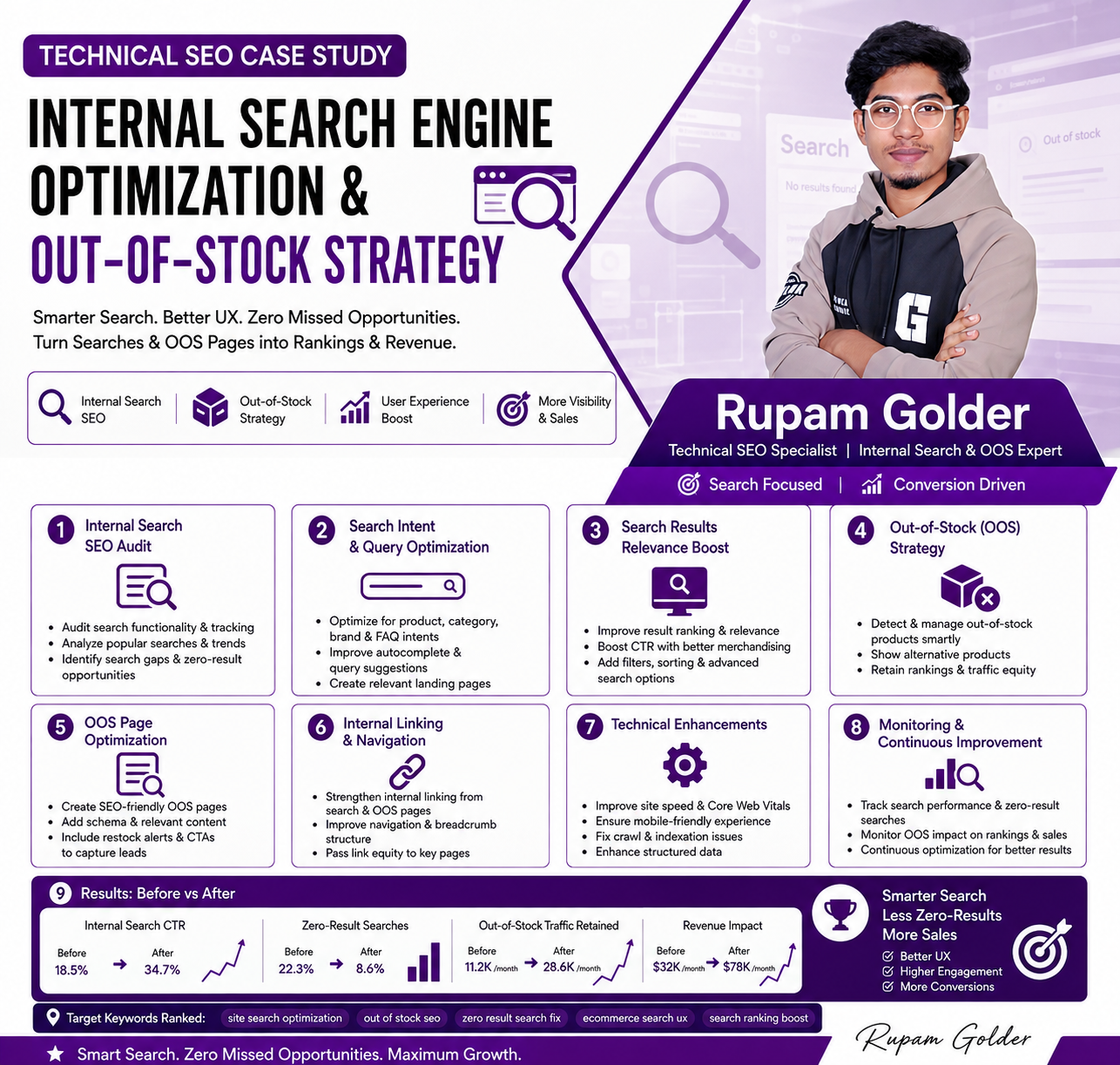
This case study focuses on how I approached Internal Search Engine Optimization & Out-of-Stock Strategy for an e-commerce website. The objective was to improve product discovery, understand what customers were searching for internally, and create a smarter system for handling products that were temporarily unavailable or permanently discontinued.
I’m Rupam Golder, an SEO Specialist, and my approach to e-commerce SEO is always focused on the complete customer journey. I don’t look only at how a website performs on Google. I also look at what happens after a visitor arrives, how easily they can find the right product, and what happens when the product they originally wanted is no longer available.
Understanding the Initial Problem
When I started reviewing the website, I noticed that the internal search system was not being used as an SEO and conversion opportunity. The search function existed, but there was limited attention on what customers were actually searching for, which searches were returning poor results, and what users did after finding or not finding a product.
At the same time, the website had a large number of products that periodically went out of stock. Some products were temporarily unavailable, while others were no longer going to be sold. The problem was that these two situations were not being handled consistently.
Some unavailable products were removed too quickly, while others remained on the website without enough information or useful alternatives. This created both a user experience problem and an SEO management problem.
My first objective was therefore to understand how internal search and inventory changes were affecting the overall organic and conversion journey.
Analyzing Internal Search Behavior
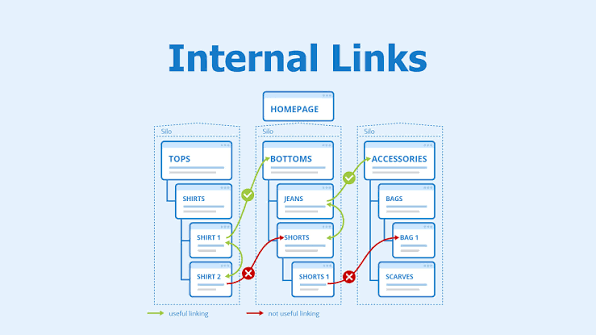
The first step was to understand what visitors were actually searching for on the website.
Internal search data can provide valuable information because users often use very specific product names, brands, features, sizes, colors, or product types when searching. These searches can reveal what customers want even when the website’s existing navigation does not make those products easy to find.
I reviewed the available internal search data and looked for repeated search terms, popular product queries, searches that returned no results, spelling variations, and queries that were producing irrelevant results.
This helped me identify gaps between what customers were looking for and what the website was actually presenting.
Improving Product Discovery
After understanding the search behavior, I focused on improving the product discovery experience.
A customer who searches for a specific product should not have to scroll through unrelated products or several pages of results. The internal search system should prioritize the most relevant products based on the search query and the user’s likely intent.
I therefore reviewed how products were being matched against search terms and how the results were being presented.
Product names, category relationships, important attributes, and relevant variations were considered so that the search system could better understand what users meant.
The objective was simple: when a customer searches for something specific, the website should make the most relevant products easy to find.
Using Internal Search Data for SEO Insights
One of the most valuable parts of this project was realizing that internal search data can also support the broader SEO strategy.
Customers sometimes search for terms that the website does not actively target through its category pages or content.
For example, if many users repeatedly search for a particular product type or feature but the website has no dedicated category or optimized landing page for it, that could represent a potential SEO opportunity.
I used these patterns to identify potential gaps in category structure, product organization, content topics, and keyword targeting.
This created a connection between internal customer behavior and external search strategy.
Fixing No-Result Searches
No-result searches were another important area of focus.
When a visitor searches for something and receives a message such as “No products found,” the customer journey can come to an immediate stop.
Instead of treating every no-result search as a dead end, I looked for opportunities to provide useful alternatives.
Depending on the query, the website could suggest related products, relevant categories, corrected search terms, or broader product groups.
This approach helps turn a potentially frustrating experience into another product discovery opportunity.
Improving Search Result Relevance
Search relevance is not only about matching exact keywords.
Customers may use abbreviations, different product names, spelling mistakes, or conversational terms that don’t exactly match the product title.
Therefore, I reviewed how the search system could better handle variations in user language.
Where appropriate, synonyms and related terms could be considered so that a search for one expression could still return products that satisfy the same underlying intent.
This was particularly useful for product categories where customers commonly use multiple names for the same type of product.
Connecting Internal Search With Category Pages

I also looked at the relationship between internal search results and category pages.
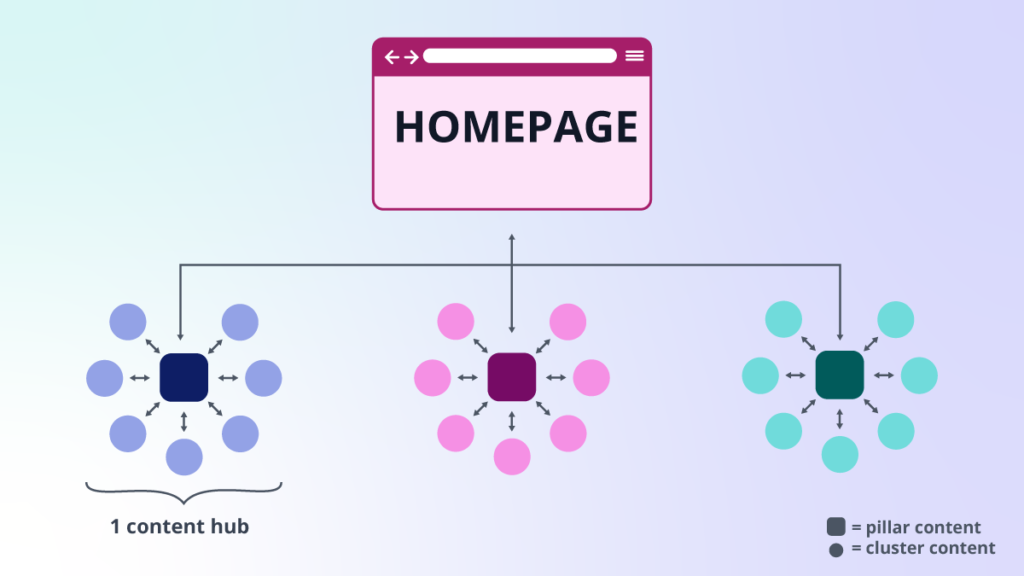
Internal search should not become a replacement for good website architecture. Instead, it should work alongside categories, subcategories, filters, and internal links.
When a user searches for a broad product type, directing them toward a relevant category or collection can provide a better experience than showing a random list of products.
This created a more natural relationship between search, navigation, category pages, and individual products.
The Out-of-Stock Product Challenge
The second major part of the project involved products that were unavailable.
Out-of-stock products are a common issue for e-commerce websites because inventory can change frequently. A product may be unavailable today but return next week, while another product may be permanently discontinued.
Treating both situations in exactly the same way can create unnecessary SEO problems.
A temporary stock shortage and a permanently discontinued product require different decisions.
Handling Temporarily Out-of-Stock Products
When a product was temporarily unavailable but expected to return, my strategy was generally to keep the product page available rather than immediately deleting it.
The page could clearly communicate that the product was currently out of stock while still providing useful information about the product.
Where appropriate, the page could offer a restock notification, related products, alternative variants, or a route back to the relevant category.
Keeping a useful product page available can preserve its existing search visibility and accumulated value while also giving customers something useful to do. This approach is consistent with established e-commerce SEO guidance that temporary stockouts generally should not automatically result in deleting the product URL.
Creating Better Alternatives for Unavailable Products
Simply displaying “Out of Stock” is not enough from a user experience perspective.
If a visitor has arrived from Google looking for a specific product and discovers that it is unavailable, the website should help them find the closest possible alternative.
I therefore focused on showing related products, similar models, alternative sizes or variants, and relevant category pages where appropriate.
The idea was to keep the customer journey moving instead of forcing the visitor to return to Google and start the search again.
Managing Permanently Discontinued Products
Permanently discontinued products required a different approach.
Before removing a product page, I considered its organic traffic, keyword visibility, backlinks, internal links, and whether a genuinely relevant replacement product existed.
If a strong and closely related replacement existed, a redirect could be considered. If there was no meaningful replacement and the old page had little ongoing value, retiring the URL could be appropriate.
The important point was to avoid applying one automatic rule to every discontinued product. The right decision depends on the page’s SEO value and whether another destination genuinely satisfies the same user intent.
Keeping Product Availability Information Accurate
Another important part of the strategy was keeping availability information consistent.
When a product is out of stock, the page should clearly communicate that status to users. Product structured data and other product information should also accurately reflect the actual availability.
This is particularly important for e-commerce websites because inconsistent availability information between the product page, structured data, and product feeds can create problems for search visibility and shopping experiences.
Improving Internal Search for Out-of-Stock Products
Internal search and inventory management were also connected.
I reviewed how out-of-stock products appeared in internal search results. If a customer searches for a product that is unavailable, completely hiding it may not always be the best solution.
Instead, the search experience can communicate that the product is currently unavailable while prioritizing available alternatives.
This approach gives customers visibility into what happened while still encouraging them toward products they can actually purchase.
For products that are permanently discontinued, however, the internal search experience should avoid repeatedly presenting dead-end results.
Balancing SEO and Conversion
One of the most important lessons from this project was that SEO and conversion should not be treated as separate systems.
A product page can have strong organic visibility but still provide a poor experience if the product is unavailable and there are no alternatives.
Similarly, a fast internal search system has limited value if it consistently returns products that customers cannot purchase.
Therefore, I focused on creating a balance between organic visibility, product discovery, inventory status, and conversion opportunities.
The goal was to keep valuable SEO assets alive while making sure customers could always find a useful next step.
Monitoring Internal Search Performance
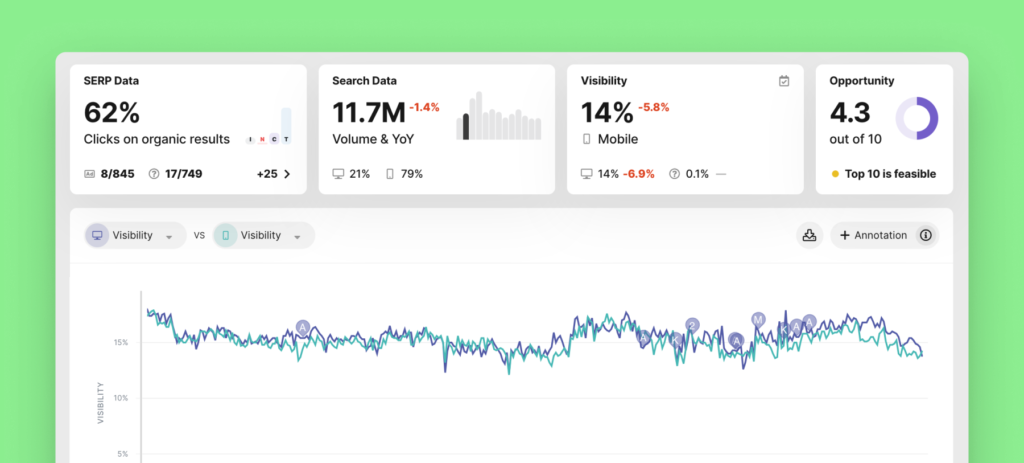
After implementing the improvements, I looked at how users interacted with the internal search system.
Important areas included popular searches, no-result searches, search refinement behavior, product clicks from search results, and the movement from search results toward product pages.
This data can help identify new opportunities over time.
For example, if a particular search term repeatedly produces no results, that may indicate a missing product, missing category, poor search matching, or even an opportunity to create a dedicated landing page.
Monitoring Out-of-Stock Pages
Out-of-stock management also requires continuous monitoring.
Inventory changes constantly, so an SEO strategy cannot depend on a one-time audit.
I focused on creating a repeatable process where product availability could be reviewed alongside organic performance.
Products that repeatedly go out of stock can be monitored for search demand and historical value, while permanently discontinued products can be reviewed for appropriate consolidation or retirement.
This makes the strategy more scalable as the product catalog grows.
The Biggest Lesson From This Project
The biggest lesson from this project was that internal search data can tell you what your customers want, while out-of-stock data can tell you where your website is losing potential opportunities.
When these two areas are analyzed together, they can provide valuable insights into product demand, website structure, content gaps, customer behavior, and conversion opportunities.
Instead of treating internal search as just a small feature in the website header and out-of-stock products as an inventory problem, I treated both as important parts of the overall e-commerce SEO strategy.
My Approach to E-commerce Search & Inventory SEO
As Rupam Golder, I believe effective e-commerce SEO should consider what happens before, during, and after a visitor reaches a product page.
My approach is to analyze how users search, how products are organized, how internal search results are presented, and how unavailable products are handled.
I focus on protecting valuable pages, improving product discovery, creating useful alternatives, and making sure that SEO decisions support both the customer experience and the business goals.
I also believe that every out-of-stock decision should be based on context. A product that is temporarily unavailable should not automatically be treated the same way as a product that has permanently disappeared.
Final Thoughts
Internal Search Engine Optimization & Out-of-Stock Strategy may not be the first thing businesses think about when they hear “e-commerce SEO,” but both areas can have a meaningful impact on organic growth and customer experience.
A well-optimized internal search system helps visitors find what they need faster and can reveal valuable insights about customer demand. A thoughtful out-of-stock strategy helps protect the SEO value of important product pages while giving customers relevant alternatives when products are unavailable.
The most important thing is to avoid treating these areas as isolated technical tasks.
They should work together with category SEO, product page optimization, internal linking, technical SEO, structured data, and conversion optimization.
Made by Rupam Golder, this case study reflects my approach to e-commerce SEO: understand what users are searching for, make products easier to discover, protect valuable organic assets, and create a clear path toward conversion—even when the original product is temporarily or permanently unavailable.
In the long run, the goal is not simply to rank more product pages. The goal is to build an e-commerce website where search visibility, product discovery, user experience, and organic revenue growth work together.