Introduction
Redesigning an e-commerce website can be exciting from a design and user experience perspective, but from an SEO standpoint, it can also be one of the riskiest projects a website can go through. Changing URLs, page structures, navigation, content, product categories, or even the entire platform can have a significant impact on existing organic visibility if the migration is not handled carefully.
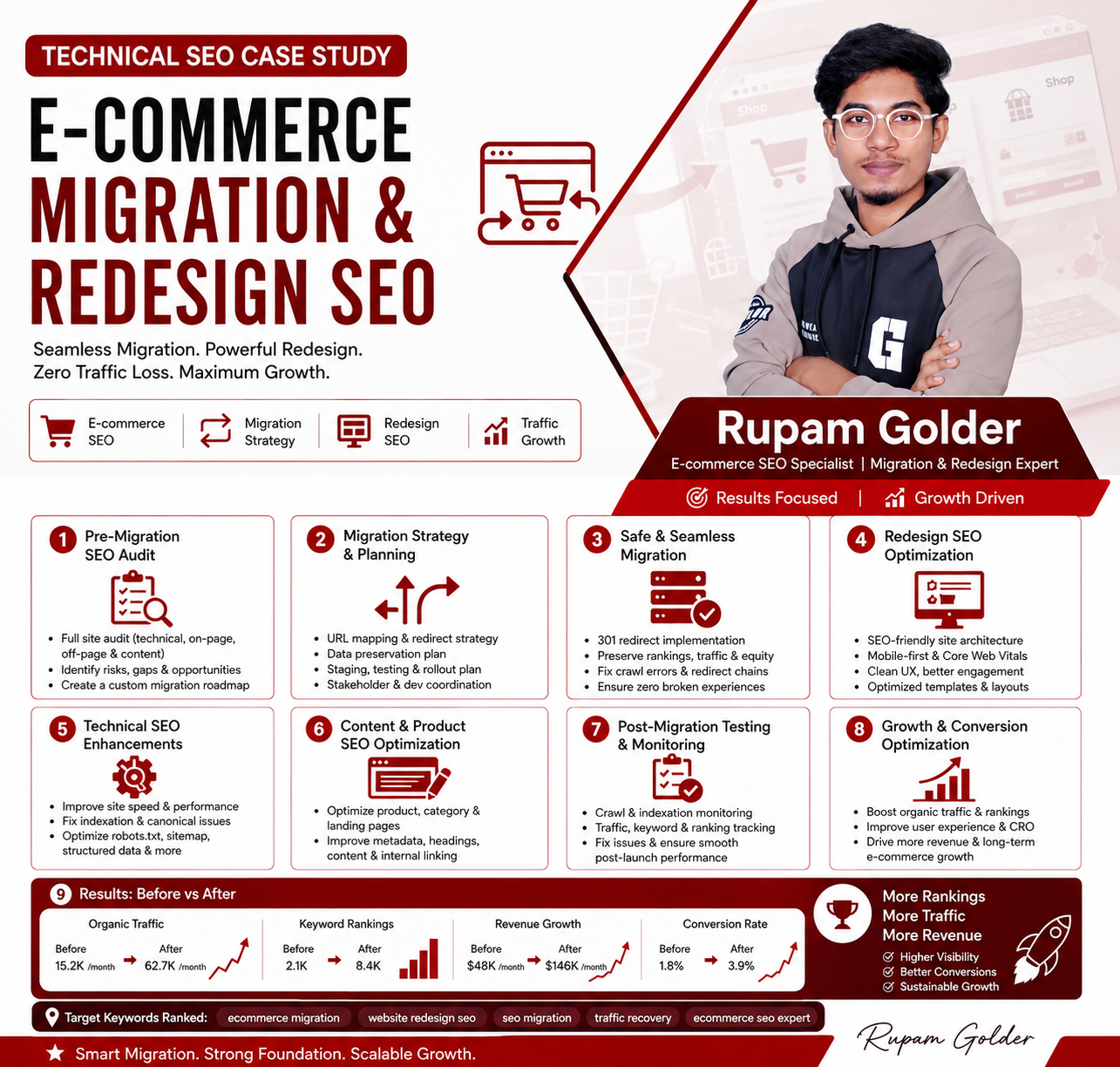
In this case study, I want to share how I approached E-commerce Migration & Redesign SEO with a focus on protecting existing search visibility while creating a stronger technical and structural foundation for future growth. The objective was not simply to launch a new-looking website. The real challenge was to make sure that the redesigned website remained search-friendly, preserved valuable SEO signals, and provided a better experience for both users and search engines.
I’m Rupam Golder, an SEO Specialist, and when I work on an e-commerce migration, I always look at it as more than a website redesign. It is an SEO transition where every important element needs to be carefully planned before the new website goes live.
Understanding the Migration Challenge
The project involved an e-commerce website that needed a major redesign and structural improvement. The existing website had accumulated organic visibility over time, including rankings, indexed pages, backlinks, internal links, and historical SEO value.
The challenge was that the new website required changes to several important elements. The design was being updated, the navigation structure needed improvement, some URLs were changing, categories were being reorganized, and certain pages were being removed or consolidated.
From a design perspective, these changes made sense. From an SEO perspective, however, every change created a potential risk.
A poorly managed migration can lead to broken URLs, lost rankings, indexing problems, redirect errors, duplicate pages, and sudden drops in organic traffic. Therefore, the SEO strategy had to start well before the redesigned website was launched.
Performing a Pre-Migration SEO Audit
Before making any changes, I started with a detailed audit of the existing website.
The purpose of the audit was to understand which pages and SEO elements were already generating value and therefore needed special protection during the migration.
I reviewed the website’s important organic landing pages, keyword rankings, indexed URLs, category pages, product pages, metadata, internal links, backlinks, canonical tags, XML sitemap, robots directives, and other technical SEO signals.
I also looked at which pages were receiving organic traffic and which URLs had valuable external links pointing toward them.
This step was extremely important because not every URL on an e-commerce website has the same SEO value.
Some pages may generate significant traffic and revenue, while others may have little or no organic importance. Knowing the difference allowed me to prioritize the migration work properly.
Creating a URL Inventory
One of the most important parts of the migration process was creating a complete URL inventory.
E-commerce websites can contain thousands of URLs, including product pages, category pages, subcategories, blog posts, filtered URLs, pagination URLs, and other automatically generated pages.
I documented the important existing URLs and compared them with the planned URL structure of the redesigned website.
This allowed me to identify which URLs would remain unchanged, which would change, which pages would be consolidated, and which URLs would no longer exist.
Having this information before launch made the redirect and migration strategy much more controlled.
Building a 301 Redirect Strategy
URL changes are one of the biggest SEO risks during an e-commerce migration.
If an old page disappears and there is no appropriate redirect, users may land on a 404 page and search engines may lose the connection between the old URL and its replacement.
To prevent this, I created a structured 301 redirect strategy.
The goal was not to redirect every old URL to the homepage. Each important old URL needed to be mapped to the most relevant new destination.
For example, if an old product category had moved to a new category URL, the old URL would be redirected to the corresponding new category rather than sending users somewhere unrelated.
This helped preserve the relationship between old and new URLs and provided a much smoother experience for both visitors and search engines.
Protecting High-Value Pages
Not every page deserved the same level of attention.
I identified high-value pages based on factors such as organic traffic, keyword rankings, backlinks, conversions, and overall business importance.
These pages received special attention during the migration.
For example, if a category page was ranking for several valuable commercial keywords and generating consistent organic traffic, I made sure its new version retained the relevant content, internal links, metadata, and SEO signals.
The idea was simple: protect what is already working before trying to improve it.
Preserving On-Page SEO Elements
A redesign often changes page content, titles, headings, images, and other on-page elements.
One common mistake is launching the new website with completely different content without considering the SEO value of the existing pages.
During the migration, I reviewed important on-page elements such as title tags, meta descriptions, H1 headings, product descriptions, category content, image attributes, and internal links.
Where existing content was already performing well, I avoided unnecessary changes.
Where content needed improvement, I optimized it carefully while maintaining the page’s original search intent.
Maintaining Search Intent
Search intent was another important consideration during the redesign.
A page that currently ranks for a specific search query should continue to satisfy the same underlying intent after migration.
If a category page is ranking because it provides users with a useful selection of products, redesigning it into a generic promotional page could negatively affect its relevance.
Therefore, I made sure that the redesigned pages maintained a clear connection between the target keywords, user intent, content, and products being offered.
Improving the New Website Architecture
The migration also provided an opportunity to improve the website’s architecture.
Instead of simply copying the old structure into the new design, I reviewed how categories, subcategories, products, and supporting content should be organized.
The objective was to create a cleaner hierarchy that would be easier for users to navigate and easier for search engines to understand.
A typical structure could look like:
Homepage → Main Category → Subcategory → Product
Supporting blog content and buying guides could then connect naturally back to relevant commercial pages.
This created a stronger foundation for future SEO growth.
Improving Internal Linking
Internal linking was carefully reviewed during the redesign.
When a website changes its navigation or page structure, existing internal links can easily become outdated or disappear.
I therefore reviewed links between categories, products, blogs, and other important pages.
The goal was to make sure that important pages remained discoverable and that internal authority continued to flow through the website logically.
I also paid attention to anchor text and contextual relevance so that internal links were useful rather than simply being added for SEO purposes.
Handling Product and Category Changes
E-commerce migrations often involve product and category changes.
Some products may be discontinued, categories may be merged, and new product collections may be introduced.
These changes require careful SEO decisions.
If a discontinued product has a strong SEO history and there is a closely related replacement, redirecting the old page to the relevant replacement may make sense.
If an old category has been replaced by a more appropriate category, the old URL can potentially be redirected to the new one.
However, I avoided automatically redirecting every removed URL. The destination needed to be genuinely relevant.
Managing Canonical Tags
Canonicalization was another technical element I reviewed during the migration.
E-commerce websites can generate multiple URLs that display similar or identical products, particularly through filters, sorting parameters, and other navigation features.
If canonical tags are incorrectly implemented on the redesigned website, search engines may receive conflicting signals about which URL should be considered the primary version.
I therefore reviewed canonical implementation across important categories, products, and other relevant page types.
The goal was to make the preferred version of each important page clear.
Reviewing XML Sitemap and Robots.txt
After the new website structure was finalized, I also reviewed the XML sitemap and robots.txt configuration.
The sitemap needed to reflect the new website structure and include the URLs that were actually intended for indexing.
At the same time, robots directives needed to be reviewed carefully to make sure important pages were not accidentally blocked.
This is particularly important during a migration because development and staging environments sometimes contain settings that should never be carried over to the live website.
Preventing Accidental Noindex Issues
One of the most dangerous migration mistakes is accidentally leaving a noindex directive on important pages.
During development, websites are sometimes configured to discourage search engines from indexing them.
If that setting remains active after launch, the new website may experience serious indexing problems.
As part of the launch checklist, I therefore reviewed indexability across important pages and made sure that production pages were available to search engines.
Checking Mobile SEO and Performance
A redesign should not only look better; it should also perform well.
I reviewed the redesigned website from a mobile SEO perspective, paying attention to responsive layouts, page loading, image sizes, JavaScript, CSS, and overall usability.
E-commerce websites often contain large product images, promotional banners, tracking scripts, and interactive features, all of which can affect performance.
The goal was to ensure that the redesign did not introduce unnecessary performance problems.
Testing the Website Before Launch
Before the redesigned website went live, I treated the staging environment as an opportunity to identify potential SEO problems before they affected real users.
I checked important URLs, redirects, navigation, internal links, canonical tags, metadata, indexability, sitemap configuration, and other technical elements.
I also crawled the website to identify broken links and unexpected status codes.
This testing phase helped reduce the risk of discovering major SEO issues only after the website had already launched.
The Launch-Day SEO Checklist
The launch itself required careful monitoring.
Once the new website was live, I checked whether the important URLs were accessible and whether redirects were functioning correctly.
I also reviewed the robots.txt file, XML sitemap, canonical tags, indexability settings, internal links, and other important technical signals.
Search Console was also monitored for unexpected indexing or crawling issues.
The objective during launch was not to make additional unnecessary changes. It was to verify that the new website was behaving as expected.
Monitoring Organic Performance After Migration
The SEO work did not end when the website went live.
Post-migration monitoring was essential because search engines need time to process the new website structure and understand the relationship between old and new URLs.
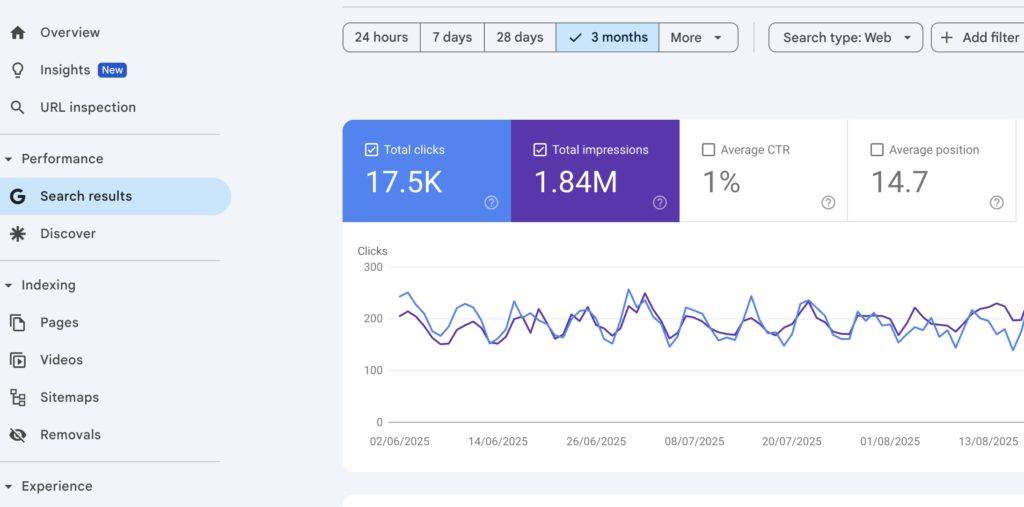
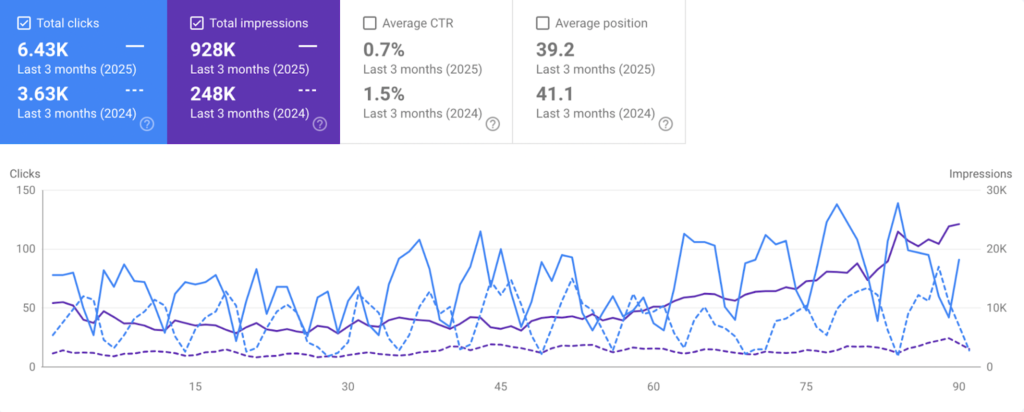
I monitored organic clicks, impressions, keyword rankings, indexed pages, crawl activity, redirects, and other important signals.
If unexpected ranking or indexing issues appeared, I investigated the underlying cause rather than immediately making random changes.
This helped ensure that the migration remained stable during the transition period.
Turning the Migration Into an SEO Opportunity
Although migration can be risky, it can also create a valuable opportunity to improve a website.
Instead of treating the redesign purely as a technical transition, I used it as an opportunity to address some of the structural issues that existed on the old website.
This included improving category architecture, simplifying navigation, strengthening internal linking, cleaning up unnecessary URLs, improving page speed, and making important pages easier to access.
The result was not just a new design but a stronger SEO foundation for future growth.
The Biggest Lesson From This Project
The biggest lesson from this project is that SEO should be involved before an e-commerce redesign begins, not after the new website is launched.
Waiting until the redesign is complete can make it much harder to recover lost URLs, rankings, content, and SEO signals.
A successful migration starts with understanding the existing website, identifying valuable pages, planning URL changes, preparing redirects, preserving important content, and testing the new environment before launch.
The redesign should serve both the business and its existing organic visibility.
My Approach to E-commerce Migration SEO
As Rupam Golder, I approach e-commerce migration as a combination of SEO planning, technical auditing, risk management, and post-launch monitoring.
My first priority is understanding what the existing website has already achieved. Then I work on protecting those valuable SEO assets while improving the areas that need attention.
I don’t believe every old URL needs to remain unchanged, and I don’t believe every new URL automatically needs to rank. The important thing is creating a logical relationship between the old website, the new website, the users, and search engines.
This approach allows a redesign to become an opportunity for long-term SEO improvement instead of becoming a reason for organic traffic loss.
Final Thoughts
An e-commerce redesign should improve more than the visual appearance of a website. When SEO is included from the beginning, the migration can also improve website architecture, user experience, technical performance, crawlability, and long-term organic growth potential.
The key areas include careful URL planning, 301 redirects, content preservation, internal linking, canonicalization, sitemap management, indexability, mobile performance, and continuous post-launch monitoring.
For me, E-commerce Migration & Redesign SEO is about protecting the SEO value a website has already built while creating a better foundation for what comes next.
Made by Rupam Golder, this case study reflects my approach to e-commerce SEO: don’t treat migration as simply moving a website from one design or platform to another. Treat it as a carefully planned SEO project where every important URL, page, keyword, and technical signal has a purpose.
A successful migration is not just a website that looks better after launch. It is a website that continues to be discoverable, crawlable, indexable, competitive, and capable of generating organic traffic and revenue after the redesign is complete.